
Understanding Coke County Releases
Release from Coke County custody means the sheriff no longer holds the person under that booking. It does not, by itself, mean the person walked into the community. Bond, personal recognizance, time served, sentence completion, dismissal, parole, mandatory supervision, and transfer are separate outcomes. Another county, the Texas Department of Criminal Justice, the U.S. Marshals Service, or ICE may become the receiving authority. The release disposition and destination are therefore as important as the time-out entry.
The Coke County Sheriff maintains the county booking and release record. The related court file explains the legal event. TDCJ holds state prison and state-jail records, while federal and immigration systems cover their own custody. A released person usually disappears from a current-custody view. Coke County does not publish such a roster anyway, so direct confirmation and an existing-record request are the reliable local route.
- Release
- The end of custody under one booking or authority.
- Transfer
- Movement to another agency, not necessarily freedom.
- Discharge
- Completion of the sentence or supervision shown by that record.
- Parole
- Conditional release from TDCJ while legal supervision continues.
Coke County Release Types
The exact term in the official record matters. A bond release does not resolve the charge. A dismissal may explain a legal outcome, but another hold can delay physical release. “Transferred” should never be rewritten as “freed.” Use the sheriff record and court docket together before drawing a conclusion.
| Record term | Meaning | Next source |
|---|---|---|
| Bond or recognizance | County custody ended under release conditions | Court bond order and sheriff time-out |
| Time served or sentence complete | County term was credited or completed | Judgment, jail credit, and release log |
| Dismissed | The court ended the stated charge | Clerk disposition and any other hold |
| Transferred | Another authority accepted custody | Receiving agency locator or records office |
| Parole or mandatory supervision | TDCJ confinement ended conditionally | TDCJ and Parole Division records |
A person can have more than one case or hold. Match the full booked name with date of birth, booking number, cause number, or agency ID whenever possible. An arrest is not a conviction, and release wording does not establish guilt or the final result of every charge.
Coke County Release Record Fields
The county website does not reveal the fields stored in its jail system. A request should name the needed data so staff can locate the existing booking sheet and release-log entry without being asked to create a new report. Ask for nonconfidential portions and allow protected details to be redacted.
| Field | What it establishes |
|---|---|
| Booked name and aliases | The identity recorded at intake |
| Booking number and time | The exact custody episode |
| Arresting and holding agency | Who brought and held the person |
| Charges and cause number | The link to the court file |
| Release date and time | When Coke County custody ended |
| Release disposition | Bond, time served, dismissal, transfer, or another code |
| Receiving agency or destination | Whether another authority took custody |
| Booking photograph | The intake image, if public after review |
Other fields may include bond type or amount, court, warrant clearance, and sentence credit. Privacy, juvenile, medical, victim, security, and law-enforcement rules can limit disclosure. A screenshot or alert is not a certified record. Ask the custodian what certified form is available when formal proof is required.
Request Coke County Release Records
Use the Coke County Sheriff Public Information Request form. Address it to Coke County Sheriff’s Office, Attn: Open Records, 13 E. 7th Street, Robert Lee, TX 76945, or email sheriff@co.coke.tx.us. The form provides spaces for contact details, incident number, occurrence date and time, request details, signature, and date.
- Identify the person with full booked name, date of birth or booking number, and an approximate booking date.
- Request the booking sheet and release-log entry, including booking and release times, disposition, receiving agency, charges, cause number, and one booking photo if needed.
- Ask for electronic, nonconfidential portions with protected information redacted.
- Keep the submitted form and proof of delivery. Ask for an estimate before work if cost matters.
- Use the cause number with the Coke County County/District Clerk to obtain the matching court disposition.
The sheriff form states that the office has ten business days to release information, seek an extension, or request an Attorney General ruling, and warns that an Attorney General ruling may take 45 days. Chapter 552 is more exact: the ten-business-day rule generally concerns requesting a ruling when information may be withheld, not a promise of production by day ten. The form follows the Attorney General cost model. It states that a $50 deposit is required when an estimate exceeds $100 and lists exact cash, money order, or cashier’s check as payment methods.
Texas Government Code Chapter 552 governs access to records held by the sheriff, county, and TDCJ, subject to its exceptions. A request needs no special phrase, but it must describe existing information well enough for the office to locate it. The office may ask for clarification when a request is too broad. Basic arrest information does not make every jail field public. Dates of birth, medical data, victim details, juvenile information, security procedures, and active law-enforcement material can require withholding or redaction. Request the segregable public portion and ask for the legal basis when material is withheld.
Ask for an existing, date-bounded record. The sheriff is not required to answer a new questionnaire or create a custom release list.
Coke Release Desk Expunction Notice
Texas Code of Criminal Procedure Chapter 55A requires the person responsible for release or discharge to provide an arrested person with a written explanation of expunction rights and a copy of the chapter. That document is a concrete item a released person can ask about at the Coke County release desk.
An expunction is a court remedy with eligibility rules. It is not the routine way to correct a misspelled name, wrong time, or other clerical error. For an error, contact the record custodian and identify the booking, cause number, disputed field, and supporting proof. A valid expunction order can restrict or remove covered records, while sealing, juvenile confidentiality, and other exceptions operate under their own rules.
Find Released Coke County Inmates
The search path begins with the last known authority. Coke County has no official online roster or recent-release feed, so there is no safe name-only list to consult. Use the official agencies and preserve each record’s retrieval date.
- Open the Coke County Sheriff page, then call 325-453-2717 with a full name and a second identifier.
- Ask whether Coke County custody ended, when it ended, and whether the disposition was community release, transfer, or another hold.
- If detail is unavailable by phone, submit the date-bounded request for the booking sheet and release log.
- Take the cause number to the combined County/District Clerk for the bond, dismissal, judgment, sentence, or commitment entry.
- When transfer or a different sovereign is indicated, repeat the check with TDCJ, BOP, or ICE.
Roster absence proves only that a name is not visible there. It does not distinguish release, transfer, data lag, misspelling, or a restricted record.
For an older event, give the sheriff a narrow date range. Court files often remain useful after an operational jail entry is no longer visible. No official Coke County online retention period was found, so do not assume that an absent web entry was destroyed.
Coke Release Records at Court
Coke County uses a combined County/District Clerk contact, and its official page offers no defendant-name search portal. Obtain the cause number from the sheriff whenever possible, then contact the Coke County County/District Clerk. The file can contain a bond order, docket events, dismissal, plea or verdict, judgment, sentence, credits, commitment, capias, warrant, and later orders.
The court record explains the legal event, but it may not establish the moment the jail opened the door. Pair it with the sheriff’s time-out and destination fields. A dismissal order cannot rule out another hold, just as a release log cannot by itself explain the final court disposition. Clerk records may also be sealed, expunged, juvenile, or otherwise restricted.
TDCJ Coke Release Search
Use the TDCJ Inmate Search only for Texas prison or state-jail custody. It is not a Coke County booking archive. A person who bonded out locally without entering TDCJ may never appear. A Coke County conviction can lead to placement at a TDCJ unit far from Coke because county of conviction and current location are different facts.
| Search field | How to use it |
|---|---|
| Last and first name | Start broadly, then verify the detail |
| TDCJ number | Best state-system identifier when known |
| SID | Helps separate people with similar names |
| Gender and race | Narrowing fields, never sole proof |
| Detail fields | Compare age, offense, county, sentence, unit, and dates |
The official search workflow is visible on the TDCJ offender-search screen.
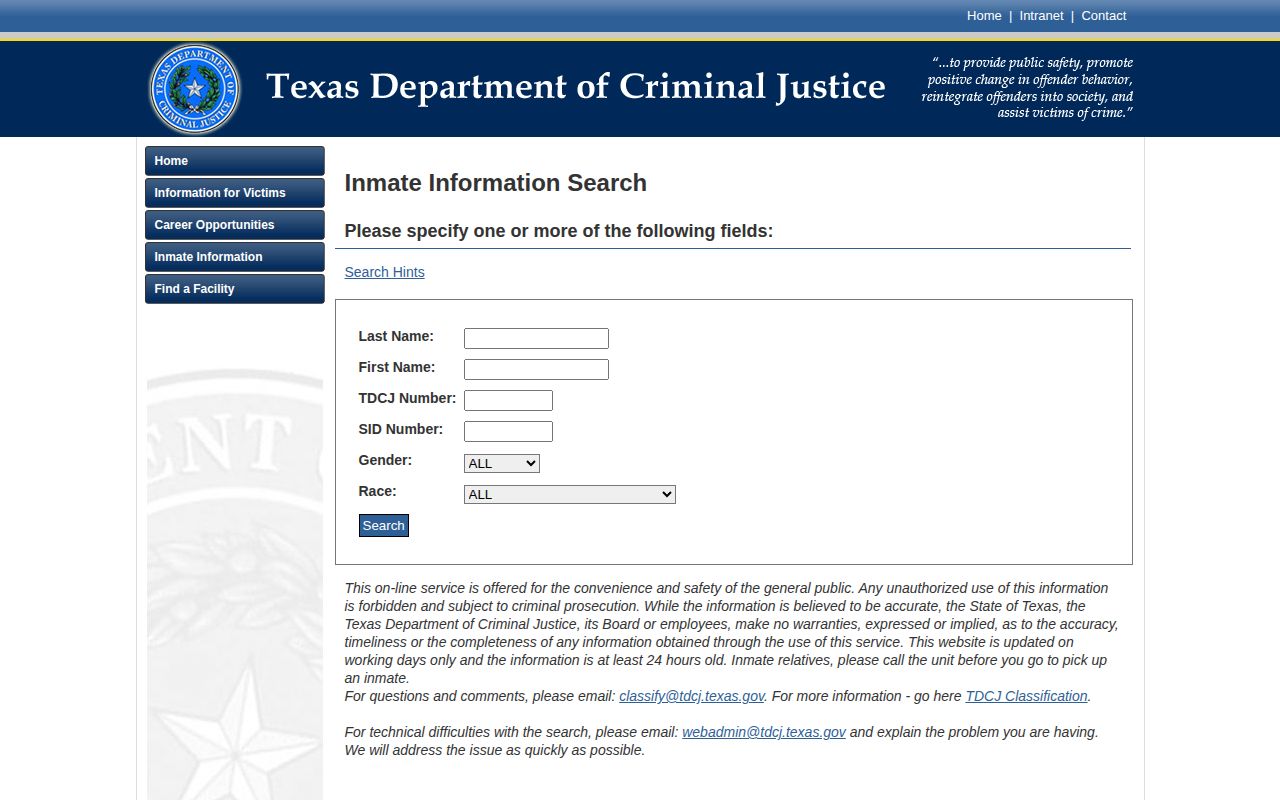
The screen supports name and number searches, but the matched detail and later release record are what make the result useful.
Keep projected release, maximum sentence, parole review, scheduled release, and actual discharge concepts separate. If the online result is unclear, TDCJ’s no-charge email route accepts the full name and seven-digit TDCJ number, or exact birth date or approximate age and county of conviction when the number is unknown. Formal release certificates and discharge records go through the TDCJ Public Information Act route.
The general-information email can return a TDCJ number, location, offenses, counties and courts tied to current and past TDCJ confinement, and the projected release date. It does not provide photographs or Social Security numbers. For a release certificate, discharge record, time calculation, or departmental identification photograph, write to PIA@tdcj.texas.gov, mail TDCJ Public Information Request at P.O. Box 4017, Huntsville, TX 77342, or use the official online request form. Identify the seven-digit number and exact record type. TDCJ records use state vocabulary and should never be relabeled as a Coke County Jail release log.
Coke Release Alerts and Locators
The Coke sheriff page still points to VINELink, but Texas moved county victim notification to Texas IVSS-Counties on September 1, 2025. Existing registrations were migrated. The current county service should control, while TDCJ IVSS separately handles state prison, parole, release, and discharge events. An alert is a prompt to verify the supplying agency’s record, not a certified release document.
Federal cases require the BOP Inmate Locator. Its “Released” or “Not in BOP Custody” wording means only that BOP no longer holds the person. BOP records begin in 1982, and dates can be recalculated. ICE ODLS covers people currently detained and those released from ICE custody within the last 60 days. A Coke-to-ICE transfer is release from county custody and continued federal civil custody, not one simple community-release event.
| Situation | Best source | Limit |
|---|---|---|
| Current Coke custody or local release | Sheriff phone and release record | No public online roster |
| Texas prison or state jail | TDCJ search and records | Does not cover ordinary county bond-outs |
| Federal sentence | BOP locator and FOIA | Exit from BOP may lead elsewhere |
| Immigration detention | ICE ODLS | Released-person window is limited |
| Legal case result | Coke County/District Clerk | Does not prove physical release time |
Coke State Release Count
The TDCJ FY2024 Statistical Report records three releases associated with Coke as the county of conviction: two prison releases, one state-jail release, and zero SAFP releases. The small count still shows why a statewide TDCJ check matters even though no current TDCJ unit was identified in Coke County.
These figures are not Coke County Jail releases. They do not count everyone released into Coke, and they should not be read as a count of distinct local jail bookings. The report’s county-of-conviction category must stay attached to the figures.
Closed Coke Release Facility
The former Coke County Juvenile Justice Facility near Bronte is historical, not a current release-search channel. The Texas Senate reported that state officials closed it in October 2007 after an audit found serious deficiencies. Stale directories may still show the name, but it must not be treated as an operating adult jail.
Current adult county release questions go to the Coke County Jail. Historical juvenile records follow different access rules and should be directed to the responsible juvenile or state authority. Do not publish juvenile identities or infer a present release process from the old facility listing.
Coke County Release Facility
The Coke County Jail is the sole operating detention facility page in this project. It holds adult county detainees under the Coke County Sheriff. A release may lead to the community, TDCJ, another jail, federal custody, or ICE. The sheriff release disposition identifies which path applies.
No separate county prison exists. TDCJ assigns sentenced people across its statewide system, BOP uses its nationwide network, and ICE has no identified Coke County detention site or contract in the reviewed official local sources. Call before travel because the sheriff page publishes no release desk hours, pickup point, property procedure, or transportation instructions.
Public Record Search
Sponsored Results