
Coke County 72-Hour Release Access
The official Coke County Sheriff website had no 72-hour query, adjustable release filter, roster, or recent-release archive when researched on August 2, 2026. It also gave no update schedule or online retention period. A search of official navigation and common release-list terms produced no county feed. This is a dated finding about the public web channel, not a claim that the jail lacks internal booking and release records.
The correct local product is a release log bounded by a stated three-day interval. Do not substitute a commercial “inmate search” page, cached booking list, or another county’s roster. Such sources do not establish Coke County’s window or cadence. They may also combine people now held with people whose custody ended, omit transfers, or display old booking data without a reliable source date.
Set the Coke County 72-Hour Window
“The last three days” can mean three calendar dates or the 72 hours immediately before a chosen end time. State the exact beginning, ending, and time zone. That matters near midnight and when the interval crosses a weekend, holiday, or month boundary. A clear range also helps the sheriff locate an existing record without being asked to create a new analysis.
- Choose an end timestamp that matches the moment the search is being made.
- Count back exactly 72 hours and write both endpoints with the Central Time designation.
- Ask for release events, not simply people absent from current custody.
- Request the disposition and receiving authority for every responsive event.
- Label the response by its source date and count booking events separately from unique people.
A person can have more than one booking or release within a broader interval. The result should not silently treat each row as a different person. Booking numbers and timestamps help separate events. They also make it easier to connect the correct jail event with a court cause number. For a tighter same-day interval, follow the Coke County 24-Hour Release List request method.
Request Coke County Three-Day Records
Call the Coke County Sheriff at 325-453-2717 and explain that the inquiry concerns releases during a specified 72-hour period. For a single person, provide the full booked name, date of birth or age, and approximate booking date. Ask whether the person left Coke County custody, when the event occurred, and whether the disposition was community release, transfer, or another hold. A current “not here” answer does not resolve those questions.
For the full interval, use the sheriff’s Public Information Request form. A focused request can seek “the existing jail release log for custody events ending from [start timestamp] through [end timestamp], including booked name, booking number, booking and release times, release disposition, receiving agency or destination, and charge or cause number, excluding confidential fields.” The sheriff may redact protected material and determine what responsive format exists.
The form requests contact details, incident data when known, a record description, and a signature. Its terms say charges may apply. They also state that a $50 deposit may be required if the estimate exceeds $100, with exact cash, money order, or cashier’s check listed. A narrow electronic-record request can reduce ambiguity, though it cannot force the agency to compile a report it does not keep.
Note: Ask the custodian for the applicable records schedule if an older release log is unavailable; no web result does not prove destruction.
Coke County 72-Hour Release Fields
No public Coke County interface reveals its database fields. These are the recommended fields to request if an existing responsive log contains them. Each serves a specific verification need, and any non-public material remains subject to agency review.
| Field | Use within the three-day window |
|---|---|
| Booked name | Identifies the name attached to that booking event. |
| Booking number | Separates multiple custody episodes involving the same person. |
| Booking date and time | Shows when that custody episode began. |
| Release date and time | Places the event inside or outside the defined 72 hours. |
| Release disposition | Records the stated route, such as bond, time served, completion, dismissal, or transfer. |
| Receiving agency or destination | Distinguishes community release from movement into other custody. |
| Charge or cause number | Provides the bridge to the related Coke County court file. |
A booking photograph should be treated as a separately reviewed record, not presumed to be part of a release log. A release reason must also be read narrowly. “Transferred” is not the same as “time served,” and “bonded” does not establish the final result of the case. Court records explain the legal event, while the jail timestamp documents when the physical custody event ended.
Coke County Weekend Release Checks
A 72-hour interval is valuable because it can bridge days when a person checking later did not see a same-day change. It does not guarantee that processing stopped on weekends or holidays, and no Coke County release schedule was found. Do not invent set release hours, office turnaround, or a rule that every weekend event appears on the next business day.
Instead, anchor the request to event timestamps. If the requested end time falls on Monday afternoon, count back to Friday afternoon rather than asking vaguely for “the weekend.” If a likely event sits near the boundary, widen the request only enough to capture it or ask for the named booking episode. Confirm whether the recorded date is the actual jail exit time, an administrative posting time, or another system timestamp.
The Coke County jail record and court file answer different parts of the question. A bond order, dismissal, sentence, or judgment can explain why release should occur. It does not by itself prove the exact physical exit time or rule out another hold. The sheriff’s disposition and destination remain central.
Coke County Has No Release Archive
The official sheriff page shown below is a suitable source for agency contact and the records route. It is not a 72-hour feed. View the current sheriff page before relying on the absence finding because county navigation can change after the research date.
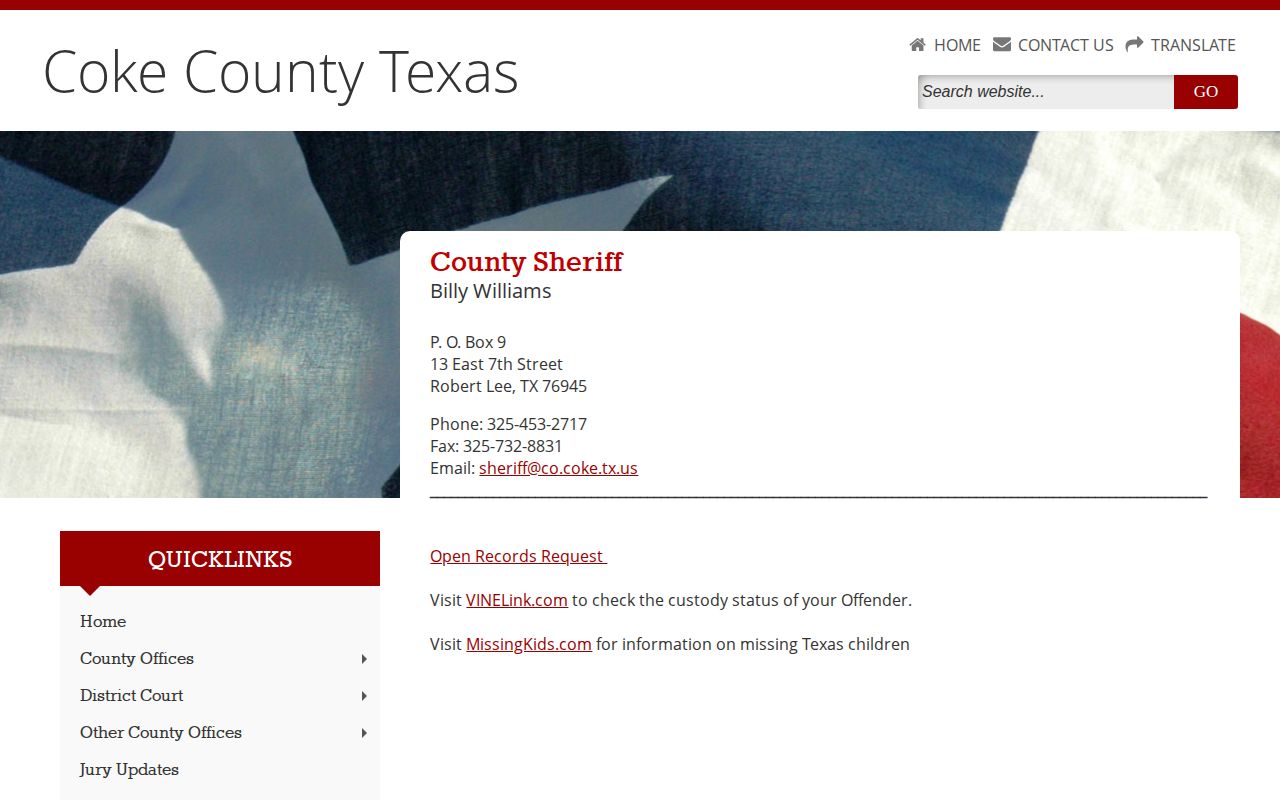
The screenshot connects the release search to a real Coke County source without suggesting that it contains fields it does not display. No official sheriff app, booking-photo gallery, or release-alert module was found in the same official sweep.
Coke County Release Fallback Chain
Use notification and state systems according to the last custodian. The Coke sheriff page retains a legacy VINELink direction, while Texas says county notifications transitioned to Texas IVSS-Counties in 2025. Search the current county notification route with exact identity details, then confirm any event with the sheriff. A notification can flag a custody change, but it is not a certified three-day log.
When the person entered Texas prison or state-jail custody, use the TDCJ offender search. A person convicted in Coke County may be held at a unit elsewhere. TDCJ can show state status, projected or scheduled release information, and parole data, but it is not a county booking archive. For federal custody, use the BOP locator. For immigration detention or a transfer to ICE, use the ICE locator within its covered period.
If the purpose is to verify one known person rather than review a three-day batch, the Coke County release-record search path organizes those custody systems by agency. Always compare identifiers. A name-only match can point to the wrong person, and an absent result is not proof of release.
Coke County Releases Versus Transfers
The most useful 72-hour result describes where the person went. A release to the community after bond or sentence completion differs from a handoff to another jail or TDCJ. A transfer to federal or immigration custody also ends the Coke County jail event without ending confinement. That is why every three-day request should seek the receiving authority or destination.
| Recorded result | Next official check |
|---|---|
| Community release | Confirm the sheriff timestamp and related Coke County court event. |
| Transfer to another county | Contact the receiving jail with the booking identity. |
| Transfer to TDCJ | Use TDCJ search and Classification and Records channels. |
| Federal transfer | Check BOP records or the federal custody path. |
| Immigration transfer | Use ICE ODLS and exact identifiers. |
Older custody events may remain available through the sheriff and clerk even though no live list exists. Retention rules differ by custodian. Ask for the historical release record, the court cause file, and the applicable records schedule when necessary rather than assigning an unsupported online retention period.
Note: A three-day log counts custody events; use booking numbers to avoid treating repeat events as several different people.