
Coke County VINELink Transition
The Coke County Sheriff page still directs visitors to VINELink. That legacy label is useful context, but it is not the full current route. The Texas Attorney General’s victim-notification page says county notification moved from VINE to Texas IVSS-Counties on September 1, 2025. Existing registrations were migrated. A returning user may need to update a password, contact method, or event choice in the new interface.
This split matters in Coke County. A booking at Coke County Jail is a county custody event. A person serving a Texas prison or state-jail sentence is in the statewide TDCJ system, even when the conviction came from Coke County. Federal Bureau of Prisons and immigration custody are outside both Texas systems. Choosing the correct system first avoids a false conclusion from an empty search.
Search Coke County Notification Records
Begin at the Attorney General’s current county portal link, then choose the jurisdiction or agency that supplied the custody data. Use the exact legal name and any known identifier. When several records look alike, compare age or date of birth, booking identifiers, and the named agency. Never rely on a name alone. The Coke County Sheriff remains the final local contact when the portal result is unclear.
- Open the current Texas county notification portal from the Attorney General’s page.
- Select Coke County or the correct participating agency.
- Enter the exact first and last name. Add an available booking or person identifier.
- Compare identity fields before opening a record.
- Read the custody status and the event timestamp together.
- Call Coke County Jail if no match appears, details conflict, or the event says transfer.
Try spelling variants and identifiers before treating a blank search as meaningful. Data can arrive after jail staff complete the physical custody event. A person may also have moved to TDCJ, another county, the U.S. Marshals, or ICE. For a broader named-person path after local release, use the Coke County released inmate search.
Search timing deserves care. Record the time the portal was checked and the time shown for the event. If a family member received a call before the screen changed, keep both facts separate until the sheriff confirms the custody log. A delayed update does not make the call wrong, and a portal change does not prove where the person went. Ask for the receiving agency whenever the disposition is a transfer.
Note: No result is not proof that a person has left Coke County custody or entered the community.
Coke County Release Alert Fields
A notification record is a status report from the agency feeding the system. The live portal controls the exact labels. Core fields help distinguish the right person and place the custody event in time, but they do not supply a full release disposition or court history.
| Field | What it can show |
|---|---|
| Name and identity details | Helps separate people with similar names; compare every available identifier. |
| Agency or jurisdiction | Shows which county or custody source supplied the event. |
| Custody status | Reports the source system’s current posted status, such as custody change or release. |
| Event timestamp | Shows when the reported event was entered or took effect, subject to agency updates. |
| Record or booking identifier | Connects the alert to a specific custody episode when the field is present. |
| Notification choices | Lists available phone, text, or email methods and the events selected. |
A released result establishes only that the supplying custody system posted a change. It may not explain the legal reason, street-release destination, another agency’s hold, sentence completion, or later supervision. Ask the Coke County Sheriff for the release date, time, and disposition, then use the court cause number to check the legal event.
The court file and custody record answer different questions. The court may show a bond order, dismissal, judgment, sentence, warrant, or commitment. The jail record shows when Coke County custody changed and, when public, the disposition or destination. Neither should be forced to answer for the other. A court order may authorize release before jail processing is complete, while a time-out entry may reflect a transfer that does not end confinement.
Register Coke County Release Alerts
Registration follows the controls shown on the current person record. Available channels and screen labels can change. Keep access credentials private, especially a PIN or one-time code. An alert is most useful when the correct record, event types, and contact methods are all checked before saving.
- Open the matched record and select its watch or notification control.
- Sign in or create the account required by the current portal.
- Choose the available phone, text, or email channels.
- Select release, transfer, or other custody events that matter.
- Complete the shown verification, such as a PIN, one-time code, link, or acknowledgement.
- Review the person, agency, event choices, and contact details, then save the confirmation.
Users migrated from VINE should review their preferences instead of assuming the old settings still match their needs. A changed phone number or blocked email can prevent delivery. Keep the confirmation for reference, but do not share another user’s confidential login or PIN.
Test each saved method if the interface offers that option. Add a second channel when available, since a phone can be off and an email can be filtered. Notification does not require constant manual searching, but it should not be the only check when timing matters. Agency staff and the source record remain the best confirmation of a specific release or transfer.
TDCJ Coke County Release Notices
TDCJ Integrated Victim Services System is distinct from Texas IVSS-Counties. It covers Texas prison and parole events rather than routine Coke County Jail bookings. The official service can notify registered users about prison release, discharge, parole eligibility, and parole decisions. A Coke County conviction does not mean the person is held in Coke County; TDCJ may assign the person to a unit anywhere in Texas.
The TDCJ Inmate Search is the matching status check. It accepts last name, first name, TDCJ number, or SID, with gender and race as added filters. Its detail can include the assigned location, offense and county, sentence, projected release date, and parole information. Those fields concern state custody. They are not a Coke County booking archive.
The official TDCJ IVSS screen shows where state notification begins. View the current TDCJ IVSS source before relying on interface instructions.
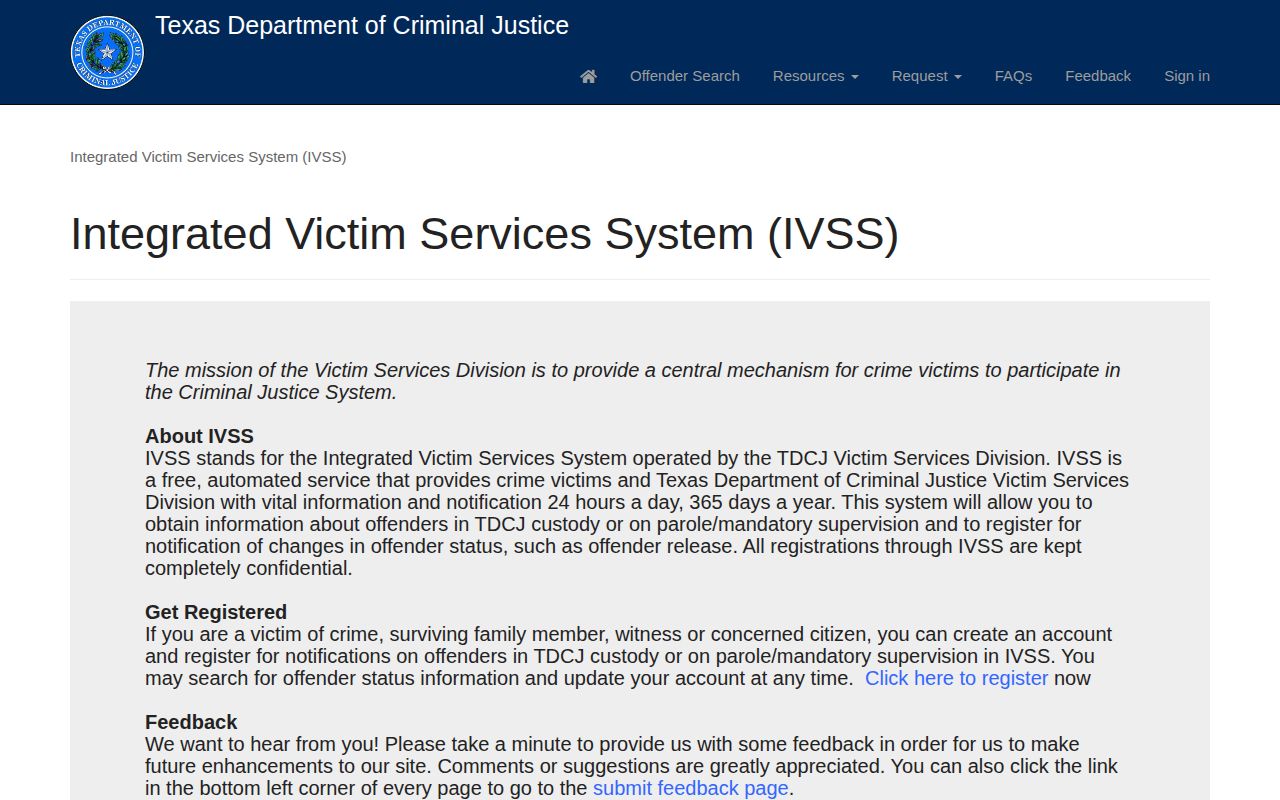
This source image reinforces the separation between state prison alerts and the county system used for Coke County Jail events.
A TDCJ projected release date can change. Parole approval may carry conditions, and a scheduled date can still change after the release certificate is audited. Treat an IVSS alert as a prompt to review the live TDCJ detail. Then distinguish parole, mandatory supervision, discharge, and transfer. Parole and mandatory supervision involve supervision after institutional release, while discharge generally reflects the end of the obligation shown by that record.
Confirm Coke County Release Alerts
Notification is corroboration, not a certified release record. After any county alert, contact Coke County Jail at 325-453-2717 and ask whether the person left Coke County custody, when the custody event occurred, and what disposition or destination the record shows. “Transfer” does not mean community release. If staff cannot provide the detail informally, use the sheriff’s written public-information request form.
For a TDCJ alert, rerun TDCJ Inmate Search and compare the status, location, projected date, parole decision, and any scheduled release data. A projected date is not a promise. For federal custody, use the BOP Inmate Locator. For immigration custody, ICE ODLS covers current detainees and people released from ICE custody within its limited recent window.
Federal results require their own limits. “Released” or “Not in BOP Custody” shows departure from BOP control, not freedom from all custody or supervision. ICE’s locator has exact-match requirements and a short window for people released from ICE detention. Neither federal system supplies a Coke County release disposition. If the Coke jail record names a federal receiving agency, move to that agency’s locator and keep the county transfer record as the link between systems.
- Release
- Departure from one agency’s custody, which may be into the community or another authority’s control.
- Transfer
- Movement from one facility or agency to another, not freedom from custody.
- Discharge
- End of the sentence or supervision obligation reflected by the governing record.
- Parole
- Conditional release from prison while the person remains under state supervision.
Why Coke County Still Says VINELink
Coke County’s official web page and the state’s current direction do not use the same label. The county still presents VINELink, while the Attorney General documents the move to Texas IVSS-Counties. That mismatch can send a user toward old branding or an account that needs updated credentials. Follow the state’s live portal first, then use the sheriff phone and written-request route if Coke County data cannot be located.
No official Coke County sheriff app was found in the reviewed county navigation. No local app should be assumed to provide alerts. The verified digital routes are the sheriff page, the Attorney General’s county-notification direction, and TDCJ IVSS for the separate state system. Interfaces and delivery methods can change, so live agency instructions take priority over saved screenshots.
Note: The county transition date identifies the notification platform change, not a change in who keeps Coke County jail records.