
Coke Parole and Probation
Texas parole and mandatory supervision follow release from the Texas Department of Criminal Justice. The person has left a prison or state jail but remains under the TDCJ Parole Division. Probation, formally called community supervision, is imposed by a court and administered by a local community supervision and corrections department. A Coke County defendant may receive probation without entering TDCJ. Bond release alone is neither status, though a court may impose separate bond terms.
The distinction controls where to verify the record. TDCJ and the Texas Board of Pardons and Paroles hold state parole information. The Coke County court file and Concho Valley Community Supervision and Corrections Department establish probation. The live Coke County Jail status cannot settle either question because a released person normally leaves the current-custody view.
| Point | Parole or mandatory supervision | Probation |
|---|---|---|
| Source | Conditional release from TDCJ custody | Coke County court order |
| Decision maker | Texas Board of Pardons and Paroles under state law | Trial court handling the criminal cause |
| Supervisor | TDCJ Parole Division | Concho Valley CSCD |
| Best proof | TDCJ detail, release certificate, and assigned-office record | Judgment or supervision order and CSCD confirmation |
| End point | Discharge, revocation, or sentence maximum as applicable | Court discharge, expiration, modification, or revocation |
- Parole
- Conditional release from a TDCJ institution before the sentence ends.
- Mandatory supervision
- A statutory form of conditional state release, subject to eligibility rules and Board review.
- Community supervision
- The Texas term commonly used for probation ordered by a court.
- Discharge
- The formal end of the sentence or supervision obligation shown by the controlling record.
Verify Coke Post-Release Supervision
Start with identity, not a name alone. The TDCJ Inmate Search accepts name, TDCJ number, State Identification number, gender, and race. Number searches are less prone to same-name error. Open the detail and compare age, offense, county of conviction, sentence, location, projected release, and parole-review information. A Coke County conviction can lead to confinement anywhere in Texas, so the unit need not be in Coke County.
If the person never entered TDCJ, use the Coke court cause instead. The combined County/District Clerk page has no public defendant-name portal. Ask for the judgment, community-supervision order, later modifications, revocation orders, and discharge. A cause number sharply narrows the request. The Coke County released-inmate search and record path explains how a sheriff release disposition and court file work together.
- Match the person by full name and a second identifier. Do not rely on name alone.
- Search TDCJ for prison, state-jail, parole, or mandatory-supervision history. Record the TDCJ or SID number and the date checked.
- Read parole-review and release fields. A favorable vote is not the same as physical release.
- For probation, obtain the Coke County judgment or order from the clerk and confirm that community supervision was imposed.
- Route parole questions to the assigned TDCJ district office and probation questions to the assigned CSCD officer.
- Confirm whether the term remains active, was changed, was revoked, or ended in discharge.
Coke Supervision Uses Two Offices
Coke County has a clear but split supervision map. The TDCJ county cross-reference assigns Coke parole cases to the San Angelo District Parole Office in Region V. That office is the logical contact when a TDCJ record shows parole or mandatory supervision and the approved residence falls within its coverage. Actual assignment follows the release plan, so the directory alone should not be treated as proof that every Coke releasee reports there.
San Angelo District Parole Office
TDCJ Parole Division, Region V
1070 Gateway Drive
San Angelo, TX 76905
Phone: 325-947-8644
Fax: 325-947-8599
Probation goes elsewhere. The Concho Valley CSCD states that it serves Coke, Tom Green, Concho, Irion, Runnels, Sterling, and Schleicher counties. Its role comes from the court order, not from TDCJ. Case-specific reporting instructions must come from the assigned officer or CSCD. This seven-county structure matters because a generic TDCJ contact cannot verify a Coke probation term.
For a favorable parole vote that has not yet produced a scheduled release, the Board FAQ identifies TDCJ Review and Release Processing at 512-406-5202. Public details may be limited for safety or operational reasons. Ask a narrow question and keep the person’s TDCJ number ready.
Note: A Coke County residence can guide office assignment, but the approved release plan and TDCJ record control the actual parole office.
Coke Parole Review Records
Initial Texas parole consideration is a file review, not a conventional public hearing. The Board review process says an institutional parole officer prepares a case summary and a three-member panel votes in sequence. Two matching votes decide the result. This means there is no ordinary monthly Coke County hearing calendar to attend. The person-specific review date in the TDCJ record is the useful timing field.
The official parole result may include a decision code rather than a plain yes or no. Approval can carry a program, transfer, or condition. Denial may include a next-review month and year or a serve-all result under the code’s definition. Even an approval may be withdrawn when new facts arrive. Read the current Board voting options, then check TDCJ for scheduled release information.
The official panel-review FAQ documents why an initial review should not be confused with a revocation hearing.
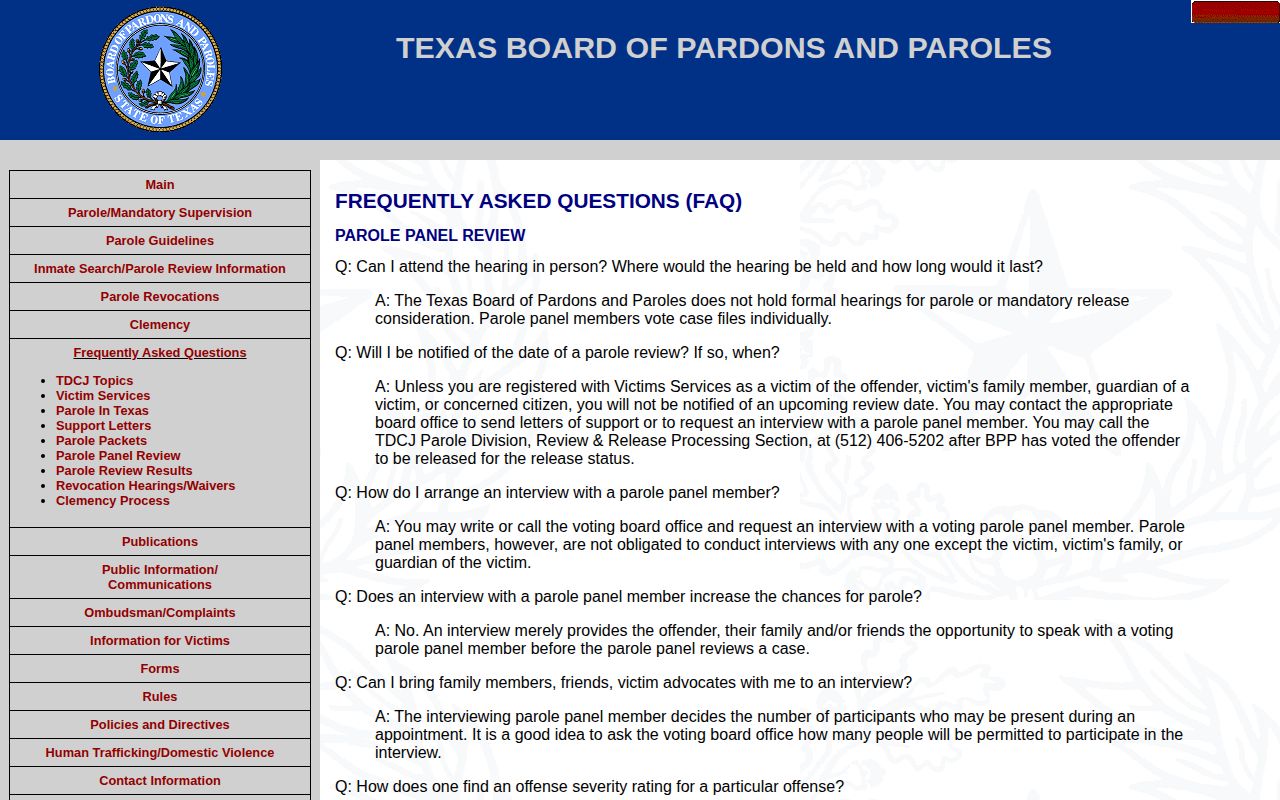
The captured panel information reinforces that the record and decision route, not a courthouse-style hearing calendar, controls initial parole review.
Coke Parole Violations and Warrants
A parole condition may address reporting, residence, travel, programs, or conduct. The specific certificate controls. If TDCJ alleges a violation, a warrant often called a blue warrant can return the releasee to custody while revocation is processed. An absconder is a person alleged to have stopped required contact or supervision. Neither label is a new conviction by itself.
Keep the sequence clear: alleged violation, warrant, jail booking if arrested, preliminary or revocation process, and final decision. Outcomes can include continued supervision, changed terms, an intermediate sanction, revocation, or discharge when appropriate. TDCJ has a sex-offender absconder search, but it covers only that specified population. It is not a list of every person alleged to have left supervision.
Texas IVSS may provide notice of state prison release, discharge, parole decisions, and related changes. It is corroboration, not a certified supervision record. Confirm the event with TDCJ or the assigned office. For immediate danger, use emergency services rather than any public locator.
Coke Release Desk Expunction Notice
Texas Code of Criminal Procedure Chapter 55A adds a concrete release-desk document. Article 55A.451 requires the person responsible for release or discharge to give an arrested person a written explanation of expunction rights and a copy of the chapter. A released person may ask whether that notice was supplied. The notice does not mean the person qualifies for expunction, and it does not alter parole or probation on its own.
An error in a Coke County release or supervision record should first go to the custodian that created it. Identify the exact booking, cause number, date, and field at issue. A routine correction is different from expunction, which is a court remedy with fact-specific rules. Likewise, an order of nondisclosure is not the same as expunction.
Chapter 55A controls the current Texas expunction framework. Restricted or expunged material should not be reconstructed from old copies when an official source no longer releases it.
Coke Supervision Discharge Records
Parole does not mean a sentence has ended. A person can live in the community while remaining in legal custody under the Parole Division. Mandatory supervision also carries conditions until discharge or another lawful end. The TDCJ release certificate, current supervision record, maximum sentence information, and eventual discharge record describe that path more accurately than a county jail roster.
Probation ends through the controlling court and CSCD record. The file may show successful discharge, expiration, early termination, modification, or revocation. Ask for the final signed order. Court disposition can establish the legal result, while the jail release log supplies the physical time and destination when custody was involved.
Use precise wording: “released from TDCJ to parole,” “released on mandatory supervision,” “placed on court-ordered community supervision,” or “discharged.” These phrases preserve the difference between leaving an institution and completing all legal supervision.