
Coke Projected and Actual Release
TDCJ defines a projected release date as the date Classification and Records calculates for release if the inmate is not paroled sooner. It is a planning field. It is not proof that the person has left custody. For some eligible older offenses, the projected point may operate as mandatory release if parole has not happened. For eligible offenses committed later, discretionary mandatory supervision may require Board approval. When mandatory supervision is denied or unavailable, the displayed projected date can be the discharge date.
A scheduled release date is a later and stronger processing event. TDCJ explains that Classification and Records audits the release certificate and then establishes the scheduled date and location. Even that date may change without notice. Actual release or discharge is the completed custody event. The Coke County release-record path can then connect the date to a sheriff log, court event, or TDCJ status.
A pretrial Coke County detainee has no sentence-based projected date. Bond may authorize release, but another warrant or hold can prevent the jail exit. A dismissal may resolve one cause while another remains. Ask the sheriff for custody status and disposition, then read the court docket.
Find Coke Projected Release Dates
The correct channel follows the sentence. For a TDCJ inmate, use the TDCJ Inmate Search. Its form accepts last and first name, TDCJ number, State Identification number, gender, and race. A number is the safest match. Open the detail and compare age, offense, county, sentence, unit, projected release, maximum sentence, and parole information. County of conviction does not mean current location, so a person convicted in Coke may be housed anywhere in the state system.
For a county sentence, call the Coke County Sheriff at 325-453-2717 and obtain the related judgment through the County/District Clerk. Ask for the sentence start, credit for time already confined, concurrent or consecutive terms, good-time calculation, holds, and the operational release date. Coke publishes no online calculator or local written computation policy. The jail and court must settle the date.
- Identify whether the person is pretrial, serving Coke County time, or serving a TDCJ sentence.
- Match the person with a TDCJ or SID number, date of birth, cause number, or booking number.
- For TDCJ, save the detail date and separately note projected release, maximum sentence, parole review, and any scheduled release fields.
- For county time, obtain the signed judgment and jail-credit entries, then ask the sheriff for its calculation.
- Check for a parole decision, program requirement, detainer, warrant, or later court order that may move the date.
- After the date passes, obtain the actual release or discharge status and the destination.
TDCJ also offers a no-charge email fallback. Its inmate-information instructions ask for the full name and seven-digit TDCJ number. Without that number, provide exact date of birth or approximate age and county of conviction. The response may include location, incarceration history, and projected release date.
The official email instructions explain the projected-date field and its inputs.
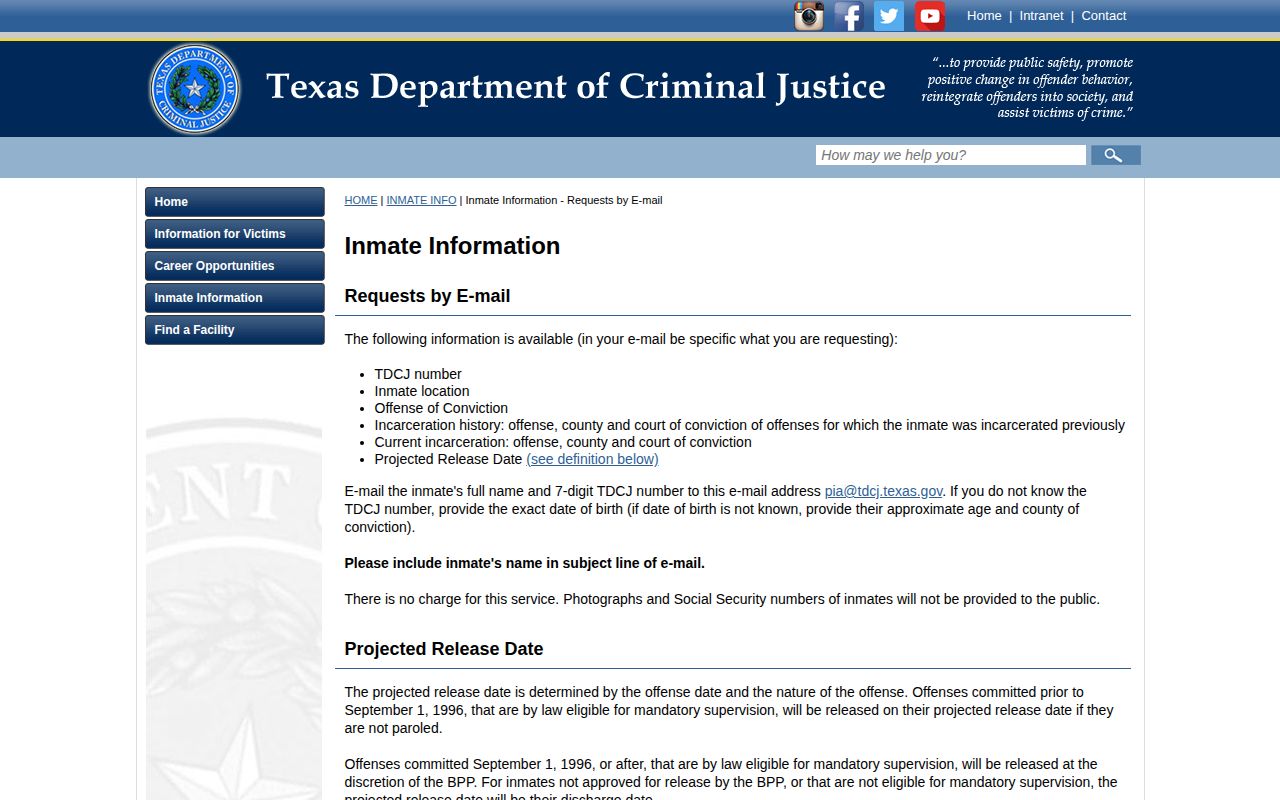
The captured TDCJ guidance supports using the agency’s own calculation instead of an unofficial sentence calculator.
Coke State Release Date Fields
TDCJ displays several dates that answer different questions. Record each one as labeled. Maximum sentence date is not parole eligibility. Parole eligibility is not approval. Approval is not physical release. A projected release date remains conditional. When release processing advances, scheduled date and location become useful, but still need confirmation after the event.
| Field | What it means | What it does not prove |
|---|---|---|
| Projected Release Date | Current Classification and Records projection if parole does not occur sooner | That release is final or already happened |
| Maximum Sentence Date | Sentence endpoint reflected by the current record | The earliest date the person can leave |
| Parole eligibility or review | Timing and status of Board consideration | Approval or a release date |
| Scheduled Release date | Date set after release-certificate receipt and audit | That no later change or hold exists |
| Scheduled Release location | Planned release destination in state processing | Final arrival or freedom from all custody |
| Actual release or discharge | Completed state custody or sentence event as labeled | Absence of another authority or ongoing parole unless stated |
TDCJ’s scheduled-release FAQ warns that a date may change, including on the scheduled day.
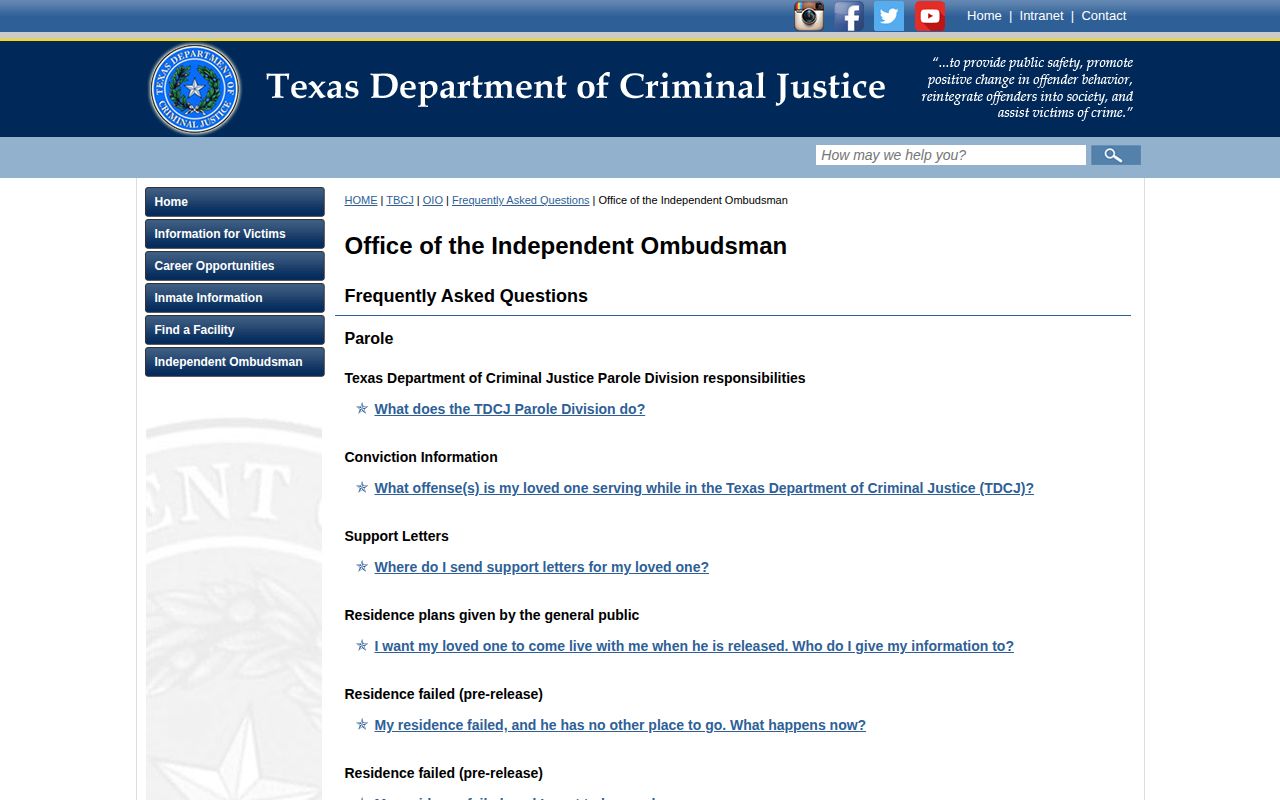
The screenshot makes the distinction practical: the newest agency field and a later status check carry more weight than an old projected date.
Note: Save the retrieval date with each TDCJ result because projected, review, and scheduled fields can change as the record is audited.
Coke State Good-Time Rules
Texas Government Code Chapter 498 governs state good-conduct time. Section 498.003 uses classification-based accrual. Trusty and Class I categories can receive 20 days for each 30 days actually served, Class II can receive 10, and Class III earns none, with other statutory provisions affecting program participation. The central limit is crucial: state good conduct affects parole or mandatory-supervision eligibility and does not otherwise reduce the sentence term. It is a privilege, not a right, and can be forfeited.
Parole eligibility is controlled by Texas Government Code Chapter 508. Section 508.145 contains different formulas based on the offense, sentence, and law in effect. For specified serious offenses, actual calendar time must meet a one-half-of-sentence or 30-year threshold, whichever is less, subject to the section’s minimums and exceptions. Good-conduct credit does not count toward that specified actual-time threshold. Section 508.149 separately excludes listed cases from mandatory supervision.
Offense date matters. So do the exact judgment and statutory category. A general web calculator cannot account for every state classification, Board choice, stacked sentence, credit, exclusion, or legal change. Use the current TDCJ record and the current statute.
No Texas 85 Percent Rule
Texas has no blanket rule requiring every TDCJ inmate to serve 85 percent of a sentence. That shorthand comes from other systems and does not describe the Texas framework. Texas instead uses offense-specific parole eligibility, mandatory-supervision rules and exclusions, actual-time thresholds for selected serious cases, sentence maximums, good-conduct classifications, and Board discretion.
This distinction is especially important for a Coke County projected release date. Two records with the same sentence length can produce different review or release paths because the offenses, dates, credits, classifications, and statutory exclusions differ. The one-half or 30-year formula in Section 508.145 for specified cases is not an 85 percent formula. Nor does parole eligibility guarantee a vote for release.
Do not estimate from sentence length alone. Read the judgment, identify the controlling statute and offense date, and use TDCJ’s calculated fields. When a Board decision is involved, use its result and wait for scheduled release processing.
Coke County Jail Date Calculation
County jail time follows a separate rule. Texas Code of Criminal Procedure Article 42.032 authorizes a sheriff to grant commutation for good conduct, industry, and obedience, up to one day deducted for each day of the original sentence actually served when no misconduct charge is sustained. The statute says the sheriff may grant the credit. A simple half-time estimate is therefore not an official Coke County release date.
The operational result can depend on the judgment, sentence start, time already confined, concurrent or consecutive structure, sustained misconduct, holds, and the sheriff’s calculation. A court order may also change the commitment. Coke County has no published local good-time policy and no public date tool, so the specific record must come from the jail and the court.
Article 42.033 allows a judge in suitable cases to permit intermittent off-work or weekend service. That does not create a statewide rule that moves a Sunday release to Friday. No Coke-specific weekend or holiday acceleration policy was found. Ask for the exact calculated date without assuming a time of day.
- Jail credit
- Time the judgment credits toward the sentence for prior confinement.
- Commutation
- A permitted reduction calculated under the county-jail good-conduct statute.
- Detainer
- A notice that another authority may seek custody, which can block community release.
- Concurrent terms
- Sentences that run at the same time, as the court orders.
- Consecutive terms
- Sentences that run one after another, as the court orders.
Why Coke Release Dates Change
A projected date can move before the person leaves custody. Changes are not always errors. Classification and Records may audit a judgment, the court may issue a new order, credits may be gained or forfeited, or another authority may lodge a hold. In parole cases, program completion and an approved residence can be required before scheduling. Board action may approve, deny, condition, or withdraw a release decision.
| Factor | Possible effect | Best confirmation |
|---|---|---|
| Sentence audit or new judgment | Changes sentence structure or credit | TDCJ Classification and Records or signed court record |
| Good-time classification or loss | Moves an eligibility or projected point where law permits | Current TDCJ or jail calculation |
| Parole action | Allows earlier conditional release, adds prerequisites, or delays release | Board result and scheduled-release record |
| Program or residence requirement | Prevents scheduling until satisfied | TDCJ release processing |
| Detainer, warrant, or hold | Causes transfer or prevents community release | Releasing agency and receiving authority |
| Court modification | Changes commitment or sentence terms | Filed and signed order |
For Coke County Jail, leaving the building may mean transfer to TDCJ, another county, federal custody, or ICE. Ask for the disposition and receiving agency, not only the time-out. For TDCJ, “Released” can still mean parole supervision continues.
Confirm Coke Actual Release Dates
Verification should continue after the projected day. Re-run the TDCJ record and look for actual release, discharge, supervision, or location changes. A state-prison alert may help, but it does not replace the agency record. The current notification route is described on the VINELink Check, including Texas IVSS distinctions.
For Coke County Jail, request the existing release log or booking-release record. Ask for booked name, booking number, release date and time, disposition, and receiving agency, with confidential fields removed. Pair it with the court judgment or order. If the person was transferred, confirm arrival with the receiving system.
A final statement should fit the evidence: projected for a future calculation, scheduled after release processing, released from a named authority, or discharged when the controlling record says the sentence or supervision ended. Those terms prevent an estimate from being mistaken for a completed release.